Captain Smollett
Captain Alexander Smollett is the master of the Hispaniola and the steadfast commander of the loyal party in Treasure Island. From his first appearance, he distinguishes himself by his blunt honesty, his insistence on proper procedure, and his deep suspicion of the voyage's secrecy—a suspicion that the mutiny of Long John Silver and his pirates soon vindicates. Though initially at odds with the enthusiastic Squire Trelawney, Smollett's cool-headed leadership, tactical foresight, and unyielding sense of duty make him the anchor of the resistance, and his authority remains unchallenged even when he is gravely wounded.
Identity and Background
Smollett is introduced as a sharp-looking man who seems angry with everything on board the Hispaniola. He is a master mariner who insists on being addressed by his proper title and who expects his commands to be followed without question. When he first meets the squire and Dr. Livesey in the cabin, he declares plainly, "I don't like this cruise; I don't like the men; and I don't like my officer. That's short and sweet." He objects that he was engaged on sealed orders but finds that every man before the mast knows more than he does about the voyage's true purpose—a treasure hunt. He also criticizes the mate, Mr. Arrow, for being "too free with the crew" and for drinking with the men, though he stops short of accusing him of drunkenness. Smollett's concern is not merely personal preference; he sees the danger in a crew that knows too much and an officer who is too familiar. He demands that the powder and arms be moved from the fore hold to a place under the cabin, that the squire's own men be berthed beside the cabin rather than forward, and that the map be kept secret even from himself and Mr. Arrow. When pressed, he admits that he had meant to get discharged, expecting the squire to refuse his requests. The squire, angered, calls his conduct "unmanly, unsailorly, and downright un-English," but Dr. Livesey recognizes Smollett as an honest man.
Leadership and Tactical Command
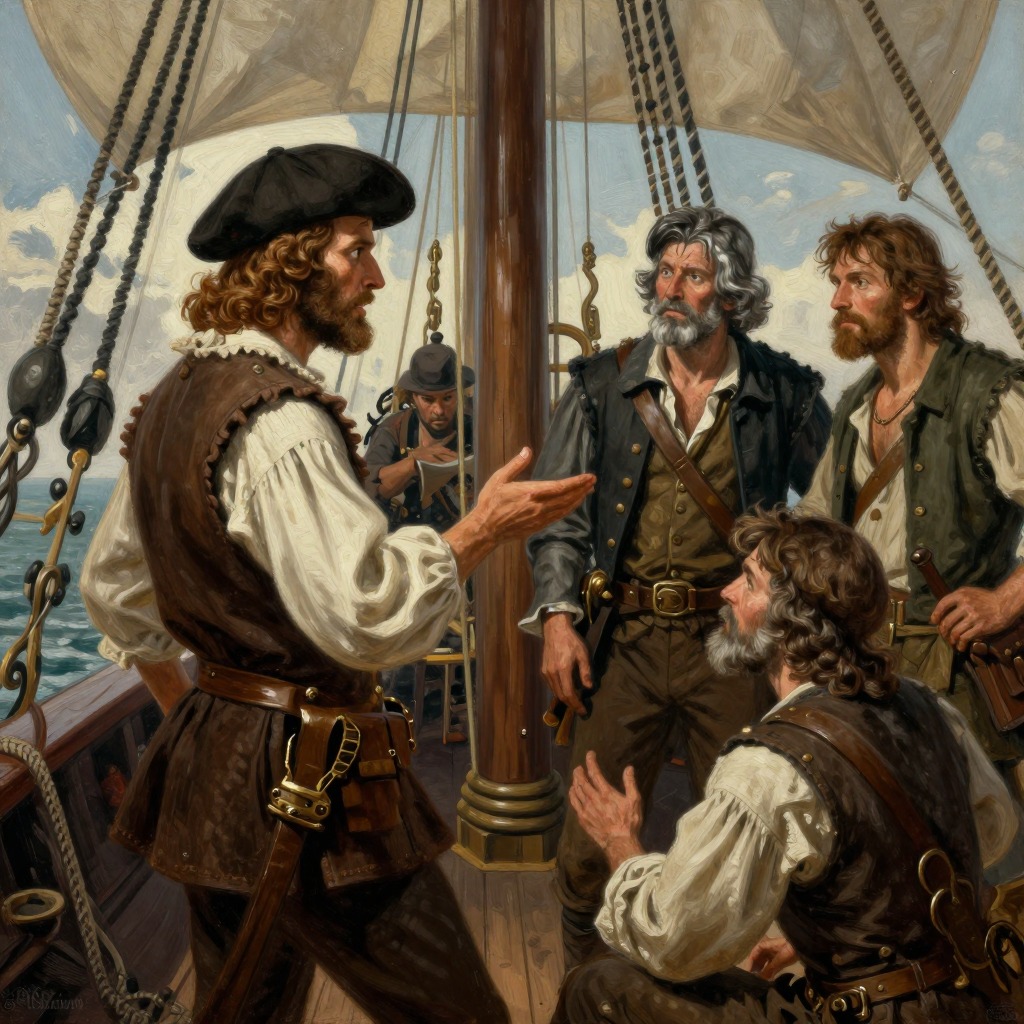
Smollett's leadership is defined by his constant vigilance and his ability to inspire discipline even in desperate circumstances. After Jim Hawkins reveals the mutiny plot overheard in the apple barrel, Smollett calmly assesses their situation: they cannot turn back, they have time before the treasure is found, and there are still faithful hands. He counts their forces—seven loyal men against nineteen mutineers—and proposes to "take time by the forelock" and strike when the enemy least expects it. When the ship reaches Treasure Island and the crew's discontent becomes threatening, Smollett devises the plan to allow the men an afternoon ashore, correctly predicting that Silver will use the opportunity to calm them. He later leads the evacuation of the Hispaniola, ordering the loyal men to load the jolly-boat with powder, muskets, biscuits, pork, and cognac while he and the squire cover the six mutineers left aboard with pistols. He calls out to Abraham Gray, giving him thirty seconds to join his captain, and Gray, with a knife cut on his cheek, runs to him. During the perilous boat trip to shore, Smollett keeps the overloaded craft from swamping, directs the squire's fire at the mutineers manning the ship's gun, and when the boat sinks in three feet of water, he wades ashore with his musket held over his shoulder, lock uppermost.
The Defence of the Stockade
Once ashore, Smollett takes command of the stockade—a log-house with a spring, a palisade, and loopholes for musketry. He immediately sets about organizing the defence: he divides the men into watches, assigns posts, and has the British colours run up on a fir-tree pole at the corner of the log-house. When a round-shot from the Hispaniola passes overhead, he refuses to strike the colours, declaring, "Strike my colours! No, sir, not I," a decision that the doctor and squire agree is both stout seamanly feeling and good policy. He keeps the men busy cutting firewood, digging a grave for the slain Tom Redruth, and cooking, all the while moving from one to another to keep up spirits. When Silver arrives under a flag of truce, Smollett refuses to let him inside the stockade, makes him sit on the sand, and listens to his offer of terms with cold contempt. He rejects the proposal outright, telling Silver that if the mutineers come up one by one unarmed, he will clap them in irons and take them to England for trial; otherwise, he will see them all to Davy Jones. He ends the parley by ordering Silver to "bundle out of this, please, hand over hand, and double quick." In the subsequent attack on the stockade, Smollett positions his men at the loopholes, assigns the north side—where the main danger lies—to the best shots, the squire and Gray, and takes the role of loader himself. When the pirates breach the palisade and the fight becomes hand-to-hand, he leads the charge with the cry, "Out, lads, out, and fight 'em in the open! Cutlasses!" He is wounded in the battle—a ball from Job Anderson breaks his shoulder-blade and touches his lung, and a second shot tears muscles in his calf—but he remains conscious and in command, asking only, "Have they run?"
Relationships and Conflict
Smollett's relationship with Squire Trelawney is strained from the start. The squire, a bluff and generous man, is offended by Smollett's bluntness and initially despises him, while Smollett remains distant and speaks only when spoken to, and then "sharp and short and dry." The squire complains that "a trifle more of that man, and I shall explode." Yet after Jim's revelation of the mutiny plot, the squire admits his error: "Now, captain, you were right, and I was wrong. I own myself an ass, and I await your orders." Smollett, for his part, does not gloat but simply says, "No more an ass than I, sir." With Dr. Livesey, Smollett has a more respectful relationship; the doctor recognizes his worth, calling him "a better man than I am." Smollett is also quick to praise those who do their duty, as when he tells Gray, "I'll put your name in the log; you've stood by your duty like a seaman." He is equally quick to rebuke those who fail, as when he finds the doctor, the squire, and Jim all away from their posts during Silver's embassy, and he angrily tells the doctor, "If that was how you served at Fontenoy, sir, you'd have been better in your berth."
Change and Ending
Smollett's wounds keep him bedridden for the remainder of the island adventure, but he continues to give orders from a mattress in the stern of the Hispaniola. He is present when the treasure is finally brought aboard, and he greets Jim with a gruff compliment: "You're a good boy in your line, Jim, but I don't think you and me'll go to sea again. You're too much of the born favourite for me." After the voyage home, Smollett retires from the sea. He is one of the five men who return to Bristol on the Hispaniola, and he receives an ample share of the treasure. His final appearance in the narrative is as a retired captain, his duty done and his authority no longer needed.
Narrative Role and Significance
Smollett functions as the embodiment of lawful authority and professional seamanship in a world overrun by mutiny and piracy. His early, accurate suspicions of the crew and his insistence on proper precautions—moving the arms, keeping the map secret, and maintaining discipline—mark him as the voice of reason that the squire and doctor initially dismiss but come to rely upon. His tactical decisions, from the evacuation of the ship to the defence of the stockade, are consistently sound, and his refusal to compromise with Silver underscores the moral clarity of the loyal party. Though he is wounded and sidelined for much of the latter part of the story, his influence persists through the orders he gives and the example he sets. Smollett is a round character in Forster's sense: he is capable of surprising, as when he admits he had meant to be discharged, and his stern exterior conceals a genuine concern for his men and a willingness to forgive, as when he accepts the squire's apology and later tolerates Silver's presence aboard the ship. He represents the ideal of the British naval officer—brave, disciplined, and unyielding—and his presence anchors the adventure in a framework of order and justice.